
Your Comfort Zone Is Costing You More Than You Think
A lot of people are not failing. They are functioning. They are getting through the week, doing what is expected, staying busy, staying distracted, and calling it a life. That is the real trap. Not chaos. Not collapse. Comfort. And comfort can keep you stuck for years while everything on the outside still looks “fine.” There is a version of your life that looks acceptable from the outside and still feels wrong on the inside. That is where many people live.
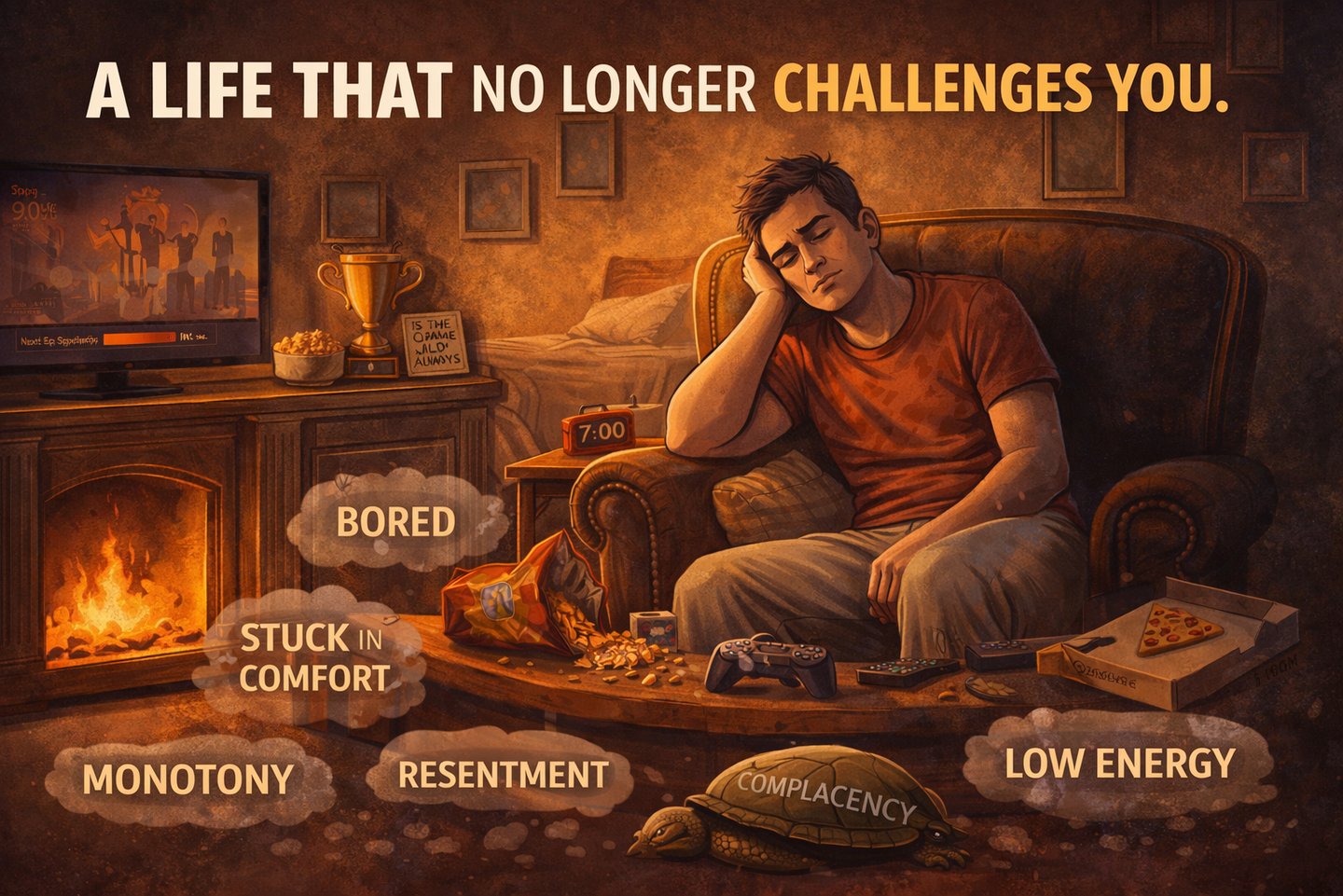
You have adapted to a life that no longer challenges you
You have a job. You pay your bills. You have routines. You may even have a relationship, a social life, and a calendar full of responsibilities. Nothing is obviously broken. But something in you knows this is not it. You feel flat. Restless. Irritated for no clear reason. You get through the day, but you do not feel fully in it.
That does not happen because you are lazy. It happens because you have adapted to a life that no longer challenges you, stretches you, or asks anything real from you.
And that is where comfort becomes dangerous.
Comfort is not always peace. Sometimes it is quiet stagnation.
A lot of people think the biggest threat to a meaningful life is failure. It is not. The bigger threat is getting used to a life that is beneath your potential. A life that is manageable, predictable, and emotionally numb. A life you did not consciously choose, but slowly accepted.
That is what makes comfort so deceptive. It does not look like a prison. It looks like stability. It looks like keeping things together. It looks like being reasonable. But when your days become built around avoiding discomfort, protecting the familiar, and staying inside old patterns, you are not free. You are contained.
You stop building your life and start maintaining it.
That is a massive difference.
The real reason people stay stuck
Most people do not wake up and decide to settle.
They drift there.
They do not choose comfort because they are weak. They default to comfort because the brain is wired for familiarity. What feels known feels safe. What feels unfamiliar feels risky. That reaction is automatic.
Your brain is not primarily designed to make you fulfilled. It is designed to keep you alive. It prefers what it has already survived. That means it often treats change as a threat, even when the change would improve your life.
Applying for a better role can feel threatening. Starting a business can feel threatening. Ending a dead relationship can feel threatening. Speaking honestly can feel threatening. Setting boundaries can feel threatening. Being seen as you really are can feel threatening.
Not because those things are wrong. Because they are unfamiliar.
That is the pattern people miss.
You do not avoid growth because growth is bad for you. You avoid it because your system reads uncertainty as danger. The problem is that many people obey that signal without questioning it. They assume that because something feels uncomfortable, it must be wrong.
It is often the opposite.
The discomfort is not always a warning. Sometimes it is evidence that you are at the edge of your current identity.
Fine is not the same as alive
A lot of people are living lives that are fine.
That word has fooled more people than failure ever did.
Fine means the bills get paid. Fine means nothing is exploding. Fine means you can explain your life to other people without embarrassment. Fine means you have learned how to function inside a pattern that no longer fits.
But fine is not the same as aligned.
Fine is not the same as engaged.
Fine is not the same as proud.
Fine is not the same as alive.
You can build a whole life around what is fine and still feel like you are disappearing inside it.
This is why people experience a constant low-level dissatisfaction they cannot explain. It shows up as mental noise, boredom, irritability, doom scrolling, procrastination, emotional eating, short temper, or a strange emptiness in moments that should feel good.
They think they need rest.
Sometimes they need truth.
They think they need motivation.
Sometimes they need movement.
They think something is wrong with them.
Often something is wrong with the way they are living.
The hidden cost of staying where you are
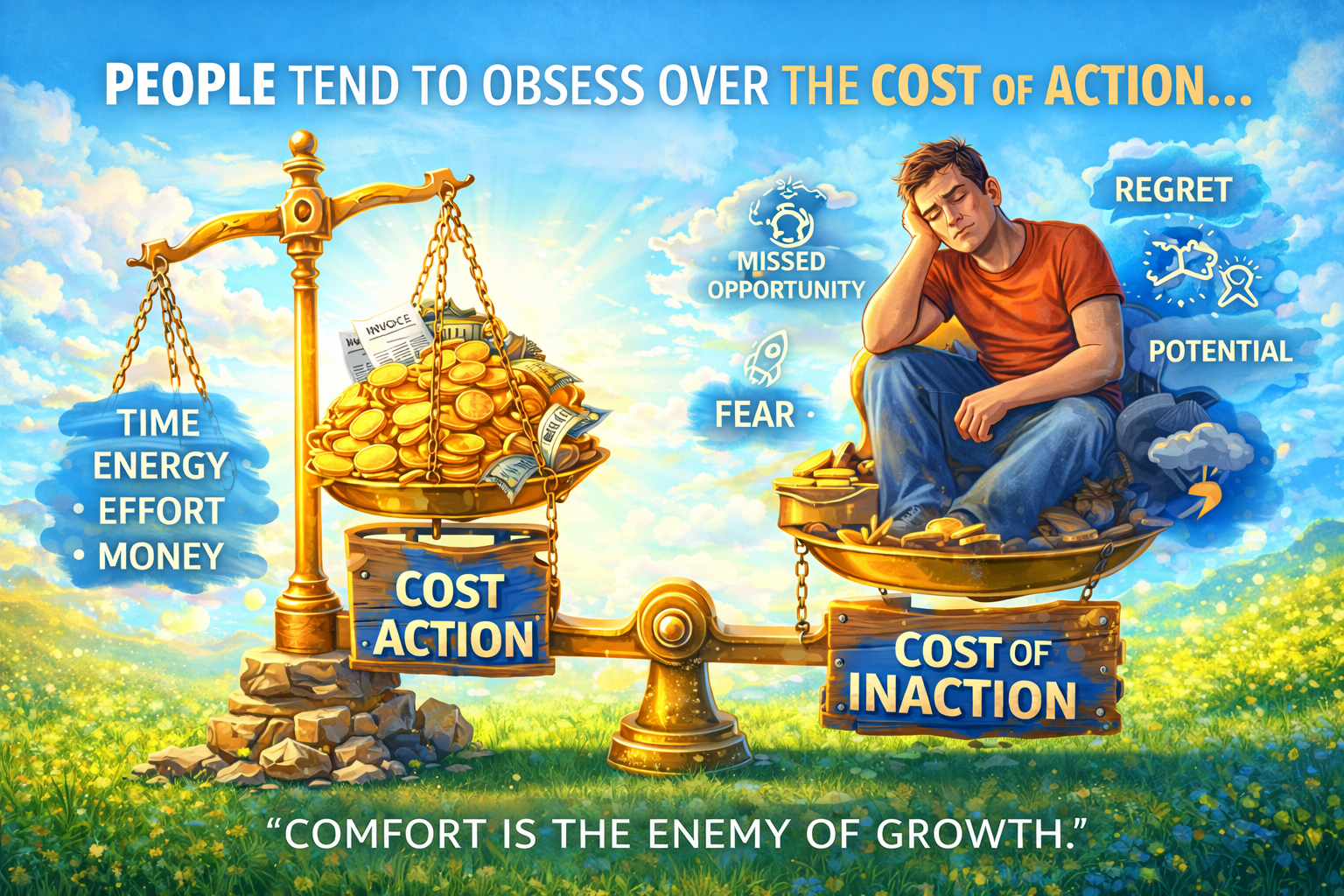
People tend to obsess over the cost of action.
What if I fail?
What if it gets hard?
What if I lose money?
What if I get judged?
What if I make the wrong move?
What if I leave and regret it?
Those questions keep people frozen because they only look at one side of the equation.
Very few people seriously examine the cost of inaction.
What does it cost you to stay where you are for another year?
What does it cost you to keep avoiding the conversation?
What does it cost you to stay in work that drains you?
What does it cost you to keep playing the role that keeps other people comfortable?
What does it cost you to keep delaying the thing you know matters?
That cost is rarely immediate, which is why people ignore it.
The cost of comfort is paid slowly.
You pay with energy.
You pay with self-respect.
You pay with clarity.
You pay with momentum.
You pay with confidence.
You pay with opportunities you were not ready for because you kept postponing growth.
And after enough time, you pay with something heavier: regret.
Not dramatic regret. Quiet regret.
The kind that shows up when you realize ten years passed and you did not really choose your life. You just kept saying yes to what was easier in the moment.
That is the real danger of comfort. It does not usually destroy your life all at once. It erodes it gradually while giving you enough convenience to stay.


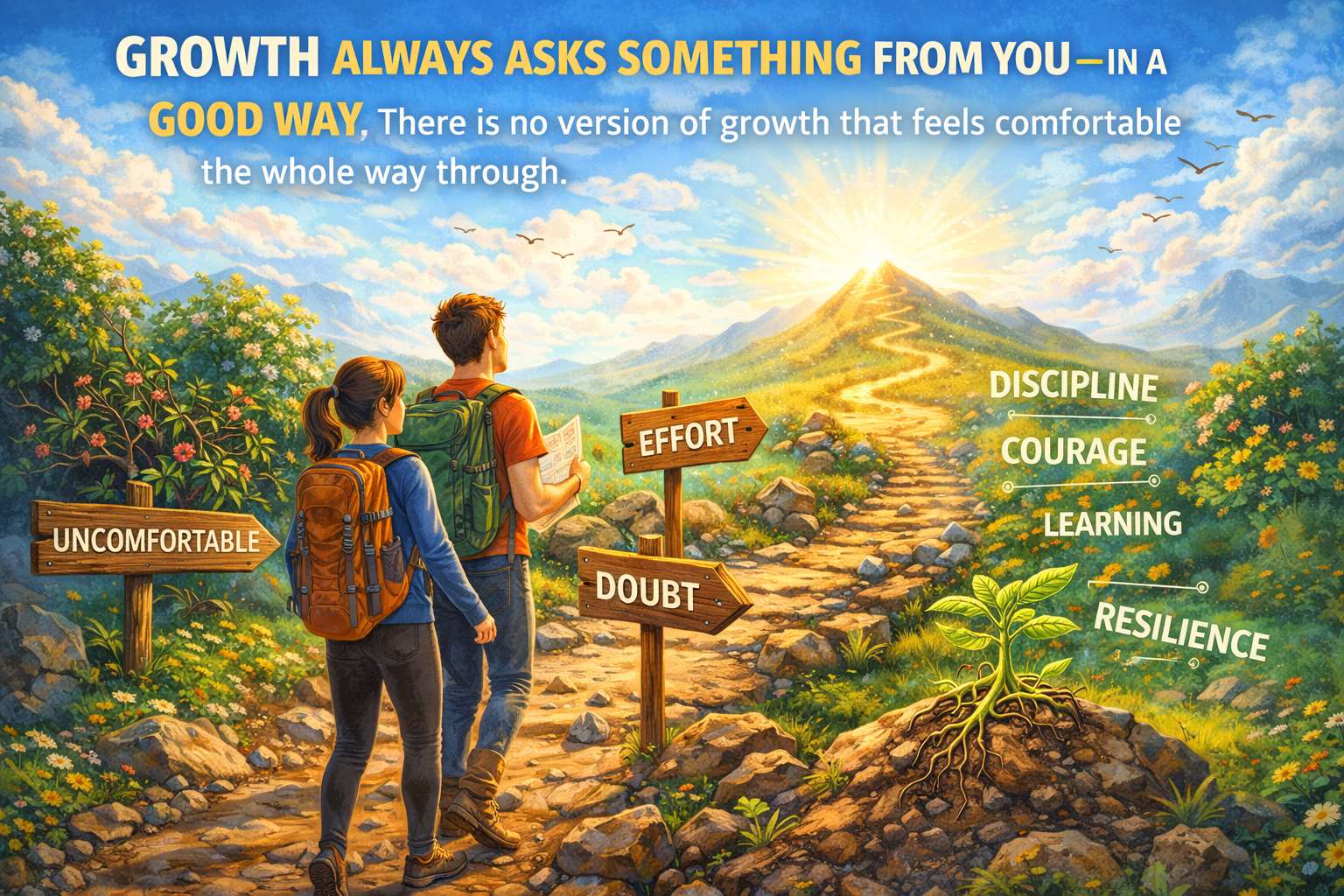
Growth always asks something from you
There is no version of growth that feels comfortable the whole way through.
You do not become stronger by staying the same.
You do not become clearer by avoiding decisions.
You do not become confident by waiting until fear disappears.
You do not become yourself by repeating what keeps you hidden.
Growth stretches you before it rewards you.
That is true physically, mentally, emotionally, and professionally. Muscles grow through stress. Communication improves through awkward honesty. confidence grows through repeated exposure to what once felt intimidating. Leadership grows when you stop waiting for certainty and start acting with responsibility.
People want the result of expansion without the experience of being stretched.
That is not how it works.
If you want a bigger life, a more honest life, a more self-respecting life, you will have to become someone who can tolerate discomfort without interpreting it as disaster.
Because once discomfort stops meaning “something is wrong,” it starts meaning “something is moving.”
Why comfort numbs more than pain
There is another cost people do not talk about enough.
Comfort does not only protect you from hard feelings. It also disconnects you from deeper ones.
When you spend your life avoiding challenge, risk, exposure, and emotional honesty, you do not just reduce pain. You reduce aliveness. You flatten the full range of your experience.
That is why many people feel uninspired even when life is stable. They are under-stimulated at a deeper level. They are not engaged in anything that demands courage, creativity, discipline, or growth. They are doing enough to survive and not enough to come fully alive.
You cannot numb one part of yourself in isolation.
When you shut down fear, you often dull excitement.
When you suppress grief, you weaken joy.
When you avoid rejection, you also avoid real intimacy.
When you avoid risk, you also avoid expansion.
This is why distraction becomes so attractive. Scrolling, binge-watching, overworking, overthinking, constant busyness. These habits do not solve the emptiness. They simply delay the moment you have to face it.
And eventually that emptiness starts speaking louder.
The pattern that keeps repeating
Many people say they want more, but their daily behavior is built around not being challenged.
They say they want freedom, but they avoid difficult decisions.
They say they want confidence, but they do not do the things that build it.
They say they want a different life, but they keep protecting the routines, relationships, and habits that keep the current one in place.
This is not a motivation problem.
It is an identity problem.
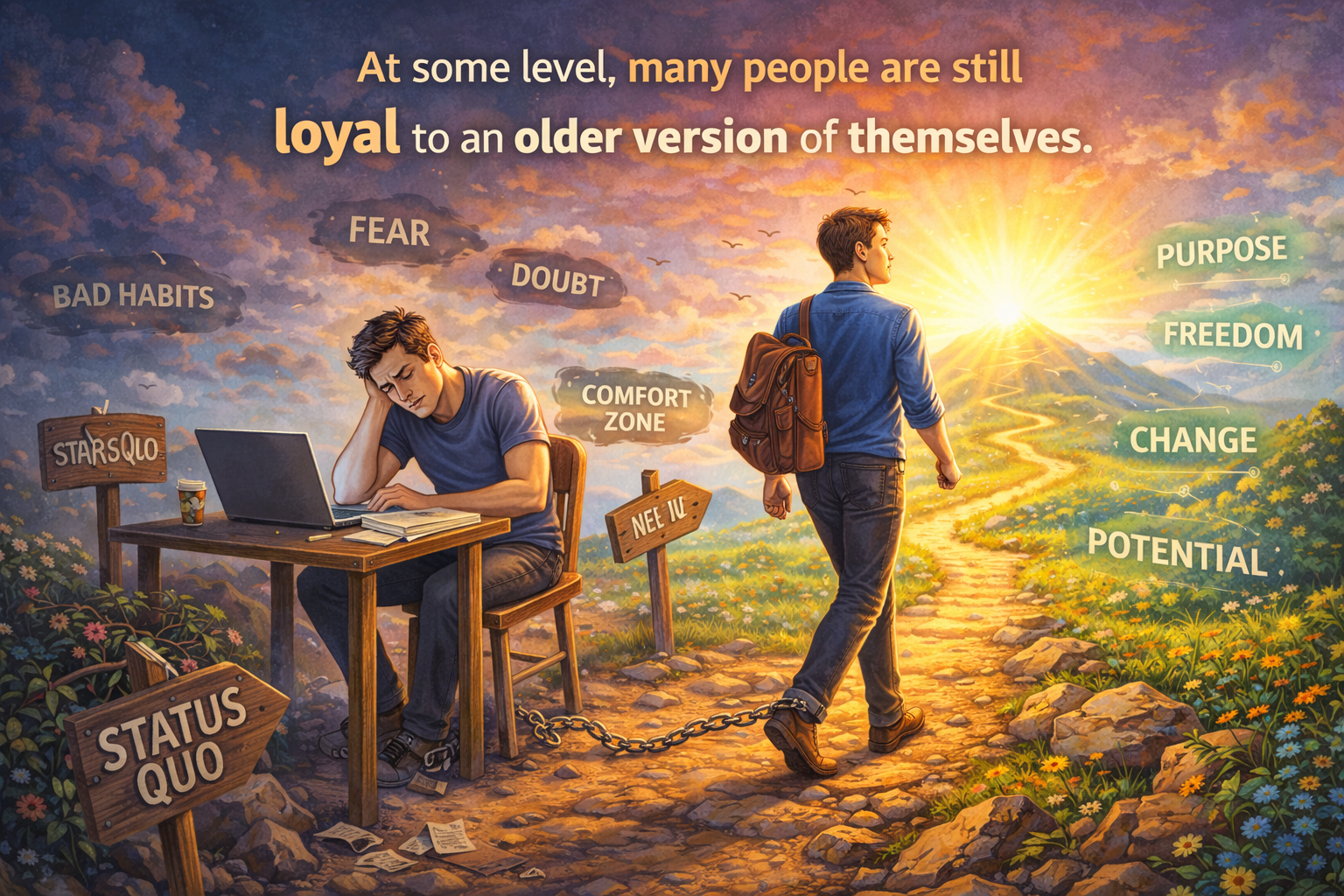
At some level, many people are still loyal to an older version of themselves.
The one who stays quiet.
The one who does not rock the boat.
The one who waits for permission.
The one who keeps the peace.
The one who is “realistic.”
The one who calls self-betrayal maturity.
That identity feels safe because it is familiar. But familiar does not mean true. It just means practiced.
You do not change your life by wanting more.
You change it by becoming unwilling to keep rehearsing who you have been.
What real change actually looks like
Real change is usually not dramatic at first.
It is not blowing up your whole life overnight.
It is not reckless decisions disguised as courage.
It is not making impulsive moves just to feel different.
Real change starts smaller and cleaner than that.
It starts when you tell the truth to yourself.
It starts when you stop calling your avoidance “timing.”
It starts when you admit that what you keep postponing matters.
It starts when you notice the exact places where comfort has become your excuse.
Then you begin to move.
You apply for the role.
You have the hard conversation.
You say no without overexplaining.
You post the work.
You ask for the opportunity.
You create before you feel ready.
You stop pretending you need more time when what you really need is more courage.
This is how people escape stagnation.
Not through one giant act.
Through repeated acts of honesty.
Stop waiting for fear to leave
A major mistake people make is believing they need to feel ready before they act.
You do not.
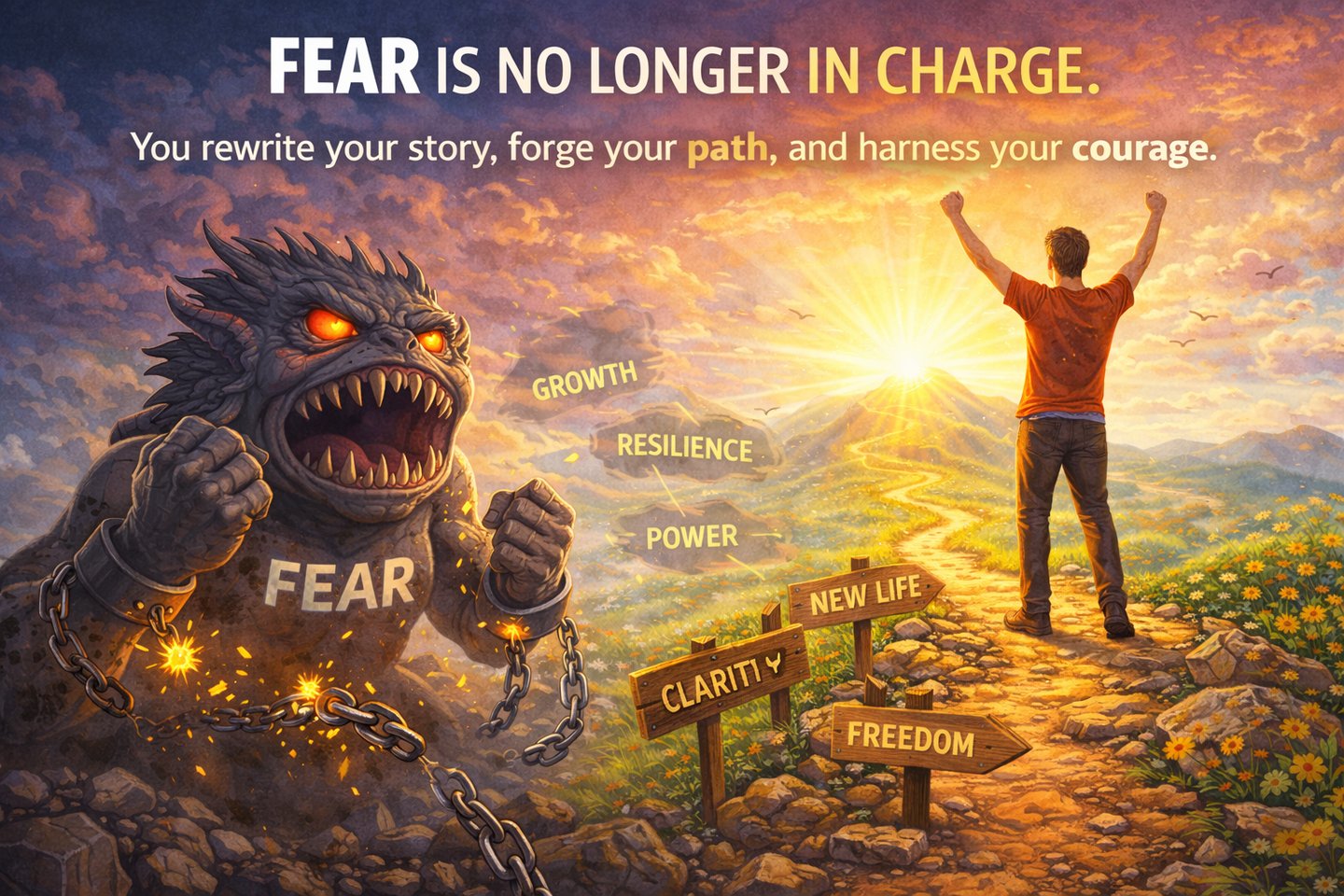
Readiness is often overrated. Most meaningful decisions in life are made with incomplete certainty. Courage does not mean fear is absent. It means fear is no longer in charge.
That matters because many people keep delaying action until the emotional discomfort disappears. They wait to feel confident before speaking up. They wait to feel clear before starting. They wait to feel calm before making the move.
And they wait for years.
Confidence is not the entry requirement. It is the result of exposure.
You build it by doing what feels difficult in measured, deliberate ways. You train your system to realize that discomfort is survivable. You prove to yourself that being seen, risking rejection, making mistakes, and trying again will not destroy you.
This is how courage becomes practical.
Not inspirational. Practical.
You stop treating discomfort like an emergency.
You start treating it like a signal that you are in motion.
Follow what keeps returning
There is usually something in your life that keeps returning to your mind.
A conversation you need to have.
A direction you want to pursue.
A standard you need to raise.
A habit you need to stop defending.
A version of yourself you know you are meant to step into.
People often ignore that inner signal because it is quiet. Fear is louder. Distraction is louder. Other people’s opinions are louder. Responsibilities are louder.
But what keeps returning matters.
You do not need to romanticize it. You do not need to make it mystical. You simply need to respect it.
There are desires that come from impulse, and there are signals that return because they are pointing to a life you are avoiding. Learn the difference.
When something keeps surfacing despite your attempts to bury it, dismiss it, or delay it, pay attention.
That repeated internal friction is not random.
It is often the cost of living out of alignment.


Redefine what safety means
A lot of people think safety means avoiding risk.
That definition is too shallow.
Sometimes what looks safe in the short term is exactly what becomes dangerous in the long term. Staying in the wrong environment can feel safer than leaving it. Staying in the underpaid role can feel safer than asking for more. Staying quiet can feel safer than being honest. Staying hidden can feel safer than being visible.
But what is the long-term price?
There comes a point where avoiding risk becomes the biggest risk in your life.
Because when you avoid every stretch, every confrontation, every uncertain next step, you do not preserve your life. You shrink it.
Real safety is not built by hiding from growth.
It is built by becoming someone who can handle reality.
Someone who can speak.
Someone who can decide.
Someone who can tolerate discomfort.
Someone who can recover.
Someone who does not collapse every time life asks for courage.
That is actual stability.
One question that will expose the truth
There is one question that cuts through a lot of noise:
What is my comfort costing me?
Not what is change costing me.
Not what is action costing me.
What is my comfort costing me?
Ask it when you are tempted to stay silent.
Ask it when you know you are settling.
Ask it when you are about to scroll instead of act.
Ask it when you keep telling yourself “later.”
Ask it when you feel restless and try to talk yourself out of it.
Be specific.
Is your comfort costing you respect for yourself?
Is it costing you intimacy?
Is it costing you momentum?
Is it costing you peace?
Is it costing you health?
Is it costing you time?
Is it costing you the life you keep saying you want?
That question matters because it shifts your focus. It moves you away from temporary discomfort and toward long-term consequence. It forces you to see that staying the same is not neutral. It is a decision with a price.


A few real examples of how this plays out
The man who stays in a job he has outgrown for five more years because the paycheck feels secure. He tells himself it is responsible. What it is really costing him is confidence, challenge, and belief in his own agency.
The woman who keeps saying yes to everyone because she does not want conflict. She appears kind and dependable. What it is really costing her is self-respect, emotional energy, and honest relationships.
The person who wants to build something meaningful but never starts because they are afraid it will be average at first. What comfort costs them is not just the project. It is trust in their own voice.
The partner who knows the relationship is dead but stays because leaving would disrupt everything. What comfort costs them is time, truth, and the possibility of a life that actually fits.
These are not small costs.
They add up quietly until one day the life you are living feels foreign to the person you could have become.
You do not need a total life overhaul today
You do not need to destroy your current life to change it.
One brave conversation.
One application.
One boundary.
One early morning.
One clear no.
One visible attempt.
One decision to stop negotiating with what you already know.
Big change is usually built through smaller acts of courage repeated consistently. That is good news because it means you do not need perfect certainty. You need willingness.
You need to stop worshipping comfort and start respecting truth.


Final thought
Your comfort zone is not always a place of rest. Sometimes it is the place where your better life keeps getting delayed.
You already know where you are shrinking.
You already know what you keep avoiding.
You already know which part of your life feels too small for who you are becoming.
Stop asking whether change will feel uncomfortable.
Of course it will.
Ask the better question:
How much longer are you willing to pay the price of staying the same?
Because the cage does not stay closed by itself.
You keep closing it.
One choice at a time.
One honest move at a time.
One act of courage at a time.


Discover how The Center for Personal Reinvention Life Optimization Coach Certification
Program™" can Support You to Dramatically Impact the Lives of Others with the same life-changing principles that Dr. Joe Rubino has used to transform lives for more than two decades!
Become a
Certified Life-Optimization Coach

Mindsetbooks.com | Copyright © 2026 All right reserved.

