
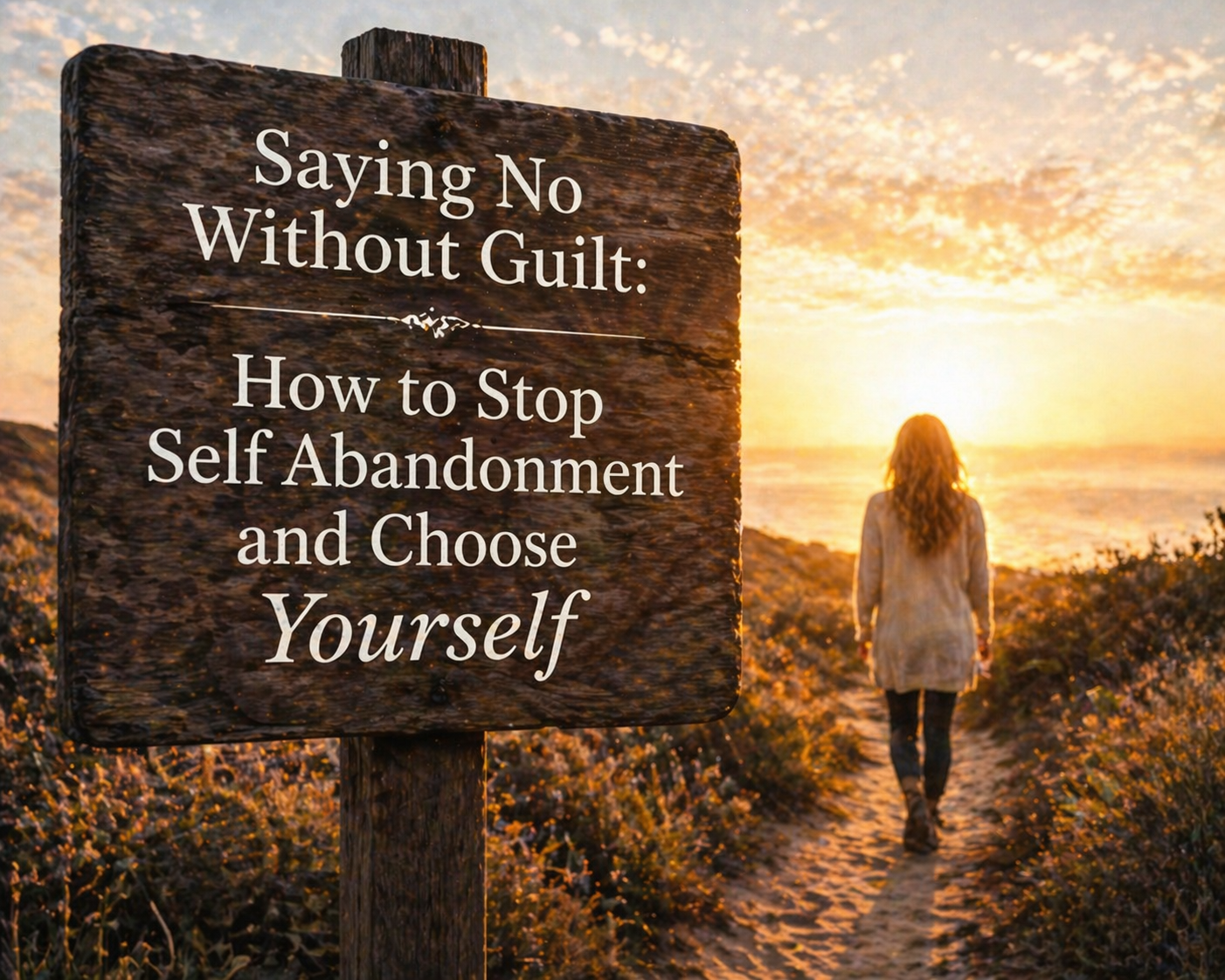
Saying No Without Guilt: How to Stop Self Abandonment and Choose Yourself
You say yes because somewhere along the way, saying no stopped feeling safe. That is the real issue. Not weak boundaries. A pattern of self-abandonment that got rewarded early and stayed with you far too long. Learn saying No Without Guilt and How to Stop Self Abandonment and Choose Yourself!


Why You Keep Saying Yes When You Want to Say No!
There is a moment almost everyone knows.
You know what you want to say.
You feel it clearly.
Your body tightens. Your stomach drops. Something in you says, no.
And then you hear yourself say, “Sure.”
Or, “That’s fine.”
Or, “No problem.”
And the conversation moves on, but you do not.
You walk away with that quiet frustration that is hard to explain. Not dramatic. Not loud. Just a familiar inner sting.
Why did I do that again?
Why do I keep agreeing when I do not want to?
Why do I keep leaving myself behind for other people?
That question matters, because this is not just about boundaries. It is about identity.
Every time you betray what you know is true for you, even in a small moment, you weaken the relationship you have with yourself. Not all at once. Slowly. Quietly. Repeatedly.
That is how people lose themselves.
Not through one major collapse.
Through daily self-abandonment.
This pattern did not come from nowhere
Most people think their problem is that they are “too nice,” “too sensitive,” or “too bad at confrontation.”
That is usually not the truth.
The truth is simpler and deeper: you learned that choosing yourself was risky.
At some point in your early life, being fully honest, fully visible, or fully yourself did not feel safe.
Maybe approval came when you performed well.
Maybe love felt conditional.
Maybe peace at home depended on staying quiet.
Maybe conflict made the environment unpredictable.
Maybe expressing needs led to guilt, criticism, distance, or rejection.
So you adapted.
You became easier.
More agreeable.
Less demanding.
More useful.
More careful.
You learned how to read the room.
How to avoid tension.
How to give people what they wanted before they had to ask.
And that adaptation probably worked.
That is the part most people miss.
You did not abandon yourself because you were broken.
You abandoned yourself because it helped you survive the environment you were in.
That pattern protected you once.
But now it is running in situations where it no longer serves you.


You are not weak. You are conditioned
That matters, because shame does not solve this.
If you keep saying yes when you mean no, it is not because you lack intelligence. Most people who struggle with this are highly aware. They know they are doing it while they are doing it.
That is what makes it so frustrating.
You can watch yourself over-explain.
You can hear yourself apologizing too much.
You can feel yourself shrinking in rooms where you should be speaking clearly.
And still, you do it.
Why?
Because awareness alone does not undo conditioning.
A pattern built through years of repetition does not disappear because you finally understand it. It changes when you start practicing something different.
That is where most people get stuck. They think insight should be enough.
It is not.
Insight helps you see the cage.
Repetition is what opens it.
Your brain is trying to keep you safe, not free
Your brain does not wake up every day asking, “How can I help this person become more honest, powerful, and self-respecting?”
It asks, “How do I avoid threat?”
And social threat counts.
Disapproval counts.
Rejection counts.
Judgment counts.
Conflict counts.
If your nervous system learned early that being disliked felt dangerous, then people-pleasing became a strategy. A very intelligent one.
The strategy sounds like this:
If I stay liked, I stay safe.
If I avoid conflict, I avoid pain.
If I keep the peace, nothing bad happens.
So when you are about to disappoint someone, your body reacts before your logic catches up.
You call it anxiety.
Your nervous system calls it protection.
That is why saying no can feel far bigger than it looks on paper.
Objectively, it may just be declining an invitation, pushing back in a meeting, or telling someone you cannot help this week.
But internally, it can feel like a threat to connection, approval, or belonging.
That is why people keep choosing short-term emotional safety over long-term self-respect.

You may be living in an adult body with outdated survival rules
This is where a lot of adults get trapped.
Your life changed.
Your age changed.
Your environment changed.
But your internal operating system did not fully update.
You are making adult decisions with old emotional wiring.
You are not that child anymore.
You are not stuck in that house anymore.
You are not dependent in the same way anymore.
But part of your nervous system still reacts as if you are.
So you over-explain to avoid being misunderstood.
You apologize to lower the chance of disapproval.
You stay too long.
Give too much.
Swallow what you really think.
Say yes when your whole body is saying no.
Not because it is true to who you are.
Because it is familiar.
And familiar often feels safer than healthy.
The real cost of saying yes when you mean no
Most people focus on the immediate benefit of people-pleasing.
No awkwardness.
No argument.
No disappointment.
No tension in the room.
That is why the pattern keeps going.
It gives relief now.
But the real cost is delayed.
Every time you override your truth, you create a small break in self-trust.
Not a dramatic collapse.
A fracture.
A tiny message to yourself that says:
“My needs are less important.”
“My discomfort matters less than theirs.”
“I do not fully have my own back.”
“Keeping others comfortable matters more than being honest with myself.”
One moment does not define you.
But repeated moments do.
This is how self-abandonment becomes identity.
You stop saying, “I keep doing people-pleasing behaviors,” and start saying, “I am a people pleaser.”
You stop saying, “I struggle with boundaries,” and start believing, “I am just not confident.”
That is what makes this dangerous. Patterns repeated long enough start to feel like personality.
They are not.
They are practiced behaviors.
And whatever has been practiced can be practiced differently.
You become what you repeat
That is the shift.
The better question is not, “Why am I like this?”
The better question is, what version of me have I been rehearsing?
Because that is what has been happening.
You have been rehearsing self-betrayal.
Rehearsing silence.
Rehearsing over-accommodation.
Rehearsing emotional caution.
That does not make you fake.
It makes you trained.
And now the work is to train in a different direction.
Not through one huge dramatic act.
Through repeated small acts of honesty.
That is how identity changes.
You do not become self-trusting by thinking about it.
You become self-trusting by proving, again and again, that when your truth shows up, you do not abandon it.


What choosing yourself actually looks like
A lot of people hear “choose yourself” and imagine something grand.
Quit your job.
End the relationship.
Move cities.
Reinvent your whole life.
Sometimes big change is needed. But most of the time, this work begins much smaller.
It starts in the micro-moments.
When you want to speak and usually stay quiet.
When you want to leave and usually stay out of guilt.
When you want to decline and usually agree.
When you want to say, “That does not work for me,” but instead say, “I can make it work.”
That is where your real life is being shaped.
Not in your big intentions.
In your small repeated choices.
Here is how to start changing the pattern.
1. Catch the micro-moments
You cannot change what you keep missing.
Most self-abandonment is fast. Automatic. You do it before you fully realize you are doing it.
So the first step is to slow down enough to notice the moments where you leave yourself.
Not once a month.
Several times a day.
Ask yourself:
Where did I say yes too quickly?
Where did I soften what I really meant?
Where did I pretend to be okay when I was not?
Where did I agree just to avoid tension?
Do not judge the answer. Just notice it.
This matters because change starts with precision. General awareness is not enough. You need to see the exact moments where your conditioning takes over.
For example:
Your colleague asks if you can take on something extra. You are already overloaded. You say yes anyway.
Your friend wants to meet. You are exhausted. You go anyway because you do not want them to feel rejected.
Your partner says something that bothers you. You laugh it off instead of addressing it.
These moments look small. They are not.
They are the training ground of your identity.
2. Stop shaming yourself and get curious
A lot of people notice the pattern and then immediately attack themselves.
“Why am I like this?”
“This is pathetic.”
“I should be over this by now.”
That response keeps the cycle alive.
Shame does not create change. It creates more fear, more collapse, and more hiding.
Curiosity is stronger.
Instead of attacking yourself, ask:
What was I afraid would happen if I told the truth?
What was I trying to protect in that moment?
What discomfort was I trying to avoid?
What did my nervous system believe was at stake?
That question opens the real door.
Because beneath the people-pleasing behavior, there is usually fear. Fear of conflict. Fear of disapproval. Fear of being misunderstood. Fear of losing connection.
When you understand the fear, you stop treating yourself like the enemy.
Now you can actually work with the pattern instead of against yourself.
3. Expect it to feel wrong at first
This is where people often quit too early.
They speak up once.
Set one boundary.
Say no one time.
And then they feel anxious, guilty, selfish, or exposed.
So they assume they did something wrong.
No.
They did something unfamiliar.
That is different.
When you have spent years training your body to equate self-abandonment with safety, self-respect will feel uncomfortable at first.
Not because it is bad.
Because it is new.
You need to stop using discomfort as proof that you are making a mistake.
Discomfort is often proof that you are interrupting an old pattern.
That first honest no may make your chest tighten.
That first boundary may leave you shaky.
That first direct conversation may keep you awake for a few hours.
That does not mean you should go back.
It means you are building capacity.
Confidence is not the absence of discomfort.
It is the willingness to stay aligned while discomfort is present.
4. Build self-trust through action
Self-trust is not a mindset trick.
It is earned evidence.
You build it the same way you build trust with another person: through consistency.
You listen to yourself.
You act on what you know.
You follow through.
You repeat it.
That is it.
When you say, “I need rest,” and you actually rest, your brain learns something.
When you say, “I do not want to do that,” and you decline, your brain learns something.
When you say, “That comment was not okay with me,” and you address it directly, your brain learns something.
The lesson is simple: I can count on myself.
That changes everything.
Because once your brain starts collecting evidence that honesty does not destroy your life, the internal conflict begins to reduce.
You do not have to keep fighting yourself as hard.
Decision-making gets cleaner.
Your body settles faster.
Your words come out more clearly.
Your respect for yourself deepens.
Not overnight.
But through repetition.
5. Let people be disappointed
This is the part many people resist the most.
You want to choose yourself, but you still want everyone to be happy about it.
That is not how this works.
When you stop over-giving, some people will notice.
When you stop being endlessly available, some people will react.
When you stop making life convenient for others at your own expense, some relationships will get uncomfortable.
That does not automatically mean you are doing something wrong.
Sometimes people are upset because they were benefiting from a version of you that had poor boundaries.
You need to understand that clearly.
Not everyone who dislikes your growth is against you in a malicious way. But their discomfort is still not your instruction.
You are allowed to disappoint people.
You are allowed to be misunderstood.
You are allowed to say no without writing a five-page emotional defense of your humanity.
That is maturity.
And the people who can only love you when you betray yourself were never offering healthy love in the first place.
Real-life examples of what this change looks like
This work needs to leave theory and enter daily life.
Here is what choosing yourself can look like:
Your boss asks for one more thing at the end of the day.
Old pattern: “No worries, I’ll handle it.”
New pattern: “I can do that tomorrow, but I do not have the capacity today.”
A friend constantly vents for an hour and never asks how you are.
Old pattern: Keep listening, feel drained, resent them later.
New pattern: “I care about you, but I do not have the space for a long call tonight.”
Your partner makes a joke at your expense in front of others.
Old pattern: Smile, minimize it, stay silent.
New pattern: “I know you meant it lightly, but I did not like that.”
Your family expects you to show up in the same role you have always played.
Old pattern: Keep performing, keep peace, feel invisible.
New pattern: “I am not available for that this time.”
These are not dramatic acts.
They are clean acts.
And clean acts build a clean identity.
You do not need to become fearless
That idea confuses people too.
They think they need to reach some future state where saying no feels effortless, conflict feels easy, and they never care what anyone thinks.
That is fantasy.
You are human.
You will still care.
You will still feel discomfort.
You will still hesitate sometimes.
The goal is not to become fearless.
The goal is to stop betraying yourself every time fear shows up.
Courage is not the absence of fear.
It is self-loyalty in the presence of fear.
That is the standard.
Not perfection.
Not performance.
Self-loyalty.
The question that matters most
At the end of your life, the real question will not be:
Was everybody pleased with me?
Did I avoid all conflict?
Did I keep everyone comfortable?
The real question is harder and more honest:
Did I live a life that was actually mine?
Because that is what self-abandonment steals.
Not just confidence.
Not just boundaries.
Your actual life.
It steals your voice slowly.
Your preferences slowly.
Your clarity slowly.
Until one day you realize you have become efficient at meeting expectations and disconnected from yourself.
That is too high a price.
So the next time you feel that hesitation, pause.
When your body says no and your mouth wants to say yes, stop for one second and ask:


What would it look like to choose myself here?
Not in a massive dramatic way.
In one honest step.
That step might be a sentence.
A pause.
A boundary.
A correction.
A refusal.
A truth spoken calmly.
Start there.
Because every time you stop leaving yourself behind, you repair something.
And eventually, those small repairs become a new identity.
One where your words match your truth.
One where your nervous system stops running your whole life.
One where you trust yourself because you have given yourself evidence that you are no longer disappearing when it matters.
Say no when no is true.
Not to become harder.
But to become whole.
TRAIN YOUR BRAIN WITH
"The Elon Code"
“You’re stuck because of a pattern you don’t even see.”
“You Start something…
"You lose momentum…
"You get distracted…
"you start again…
Sound familiar?
That’s not a motivation problem.
It’s a loop your brain keeps running automatically.
And until you interrupt it…
nothing changes.
But once you do?
Everything starts moving forward again.”



Discover how The Center for Personal Reinvention Life Optimization Coach Certification
Program™" can Support You to Dramatically Impact the Lives of Others with the same life-changing principles that Dr. Joe Rubino has used to transform lives for more than two decades!
Become a
Certified Life-Optimization Coach

Mindsetbooks.com | Copyright © 2026 All right reserved.

