
Designing Your Identity
You Think You Have an Action Problem. You Have an Identity Problem. You say you need more discipline. You say you lack motivation. But look honestly at your results. Your results don’t lie. They reveal the image you hold of yourself at a subconscious level. Designing Your Identity


You Think You Have an Action Problem. You Have an Identity Problem.
You say you need more discipline.
You say you lack motivation.
But look honestly at your results.
Your results don’t lie.
They reveal the image you hold of yourself at a subconscious level.
And that’s the real bottleneck:
You cannot consistently outperform your self-image.
Not because you’re broken.
But because your system will always pull you back to what feels “normal.”
The Pattern: Living on Autopilot
Most people never consciously build their self-image.
They inherit it.
They react to:
what they were told growing up
what they’ve experienced before
what feels “realistic”
what others might think
And meanwhile, they keep running a program they never chose.
That’s why someone can be disciplined with health but not with money.
Or ambitious in business but self-sabotaging in relationships.
Designing Your Identity
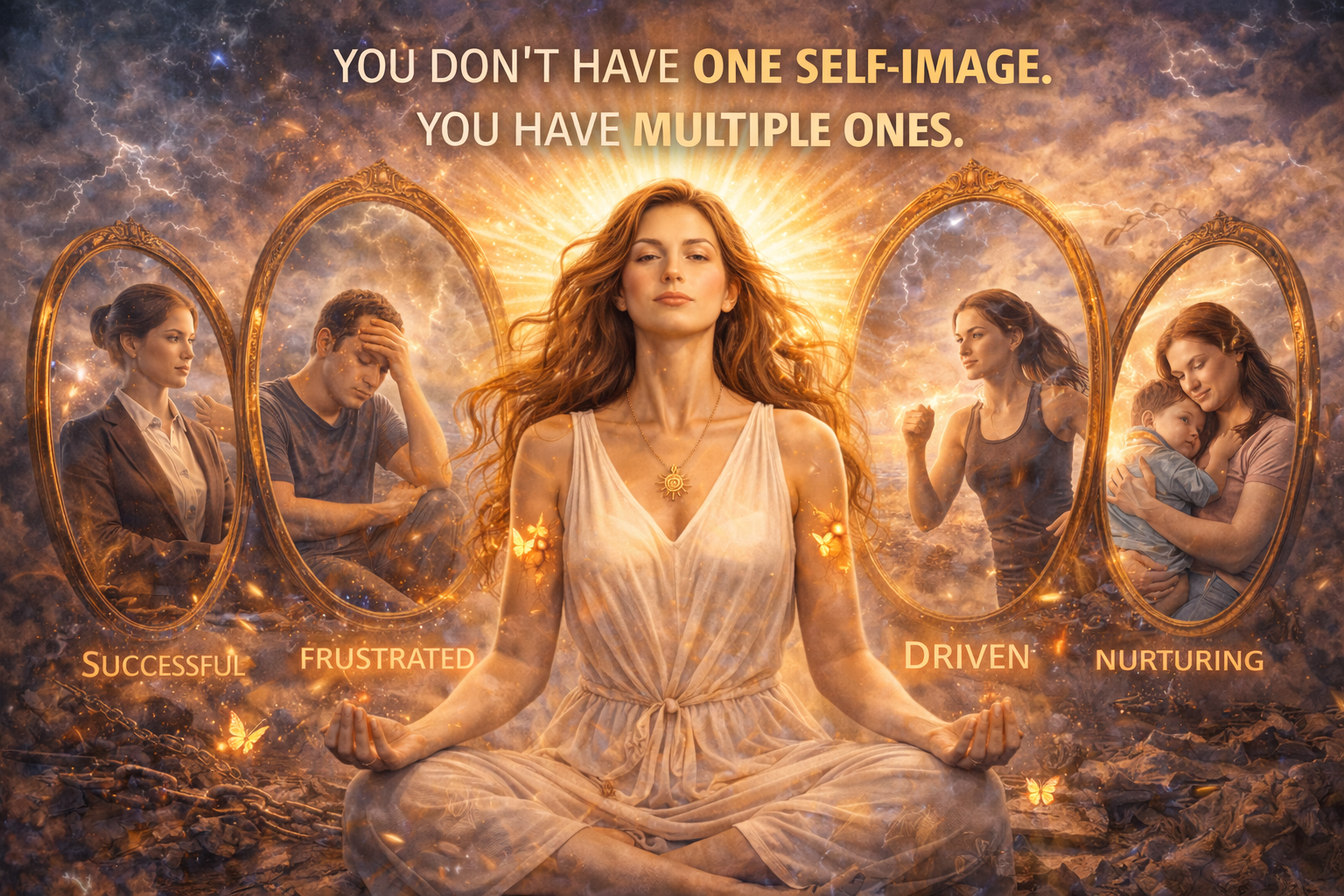
You don’t have one self-image. You have multiple ones
And your results show exactly where you think big—and where you play small.
The Mirror: How Your Self-Image Shows Up
You don’t need deep reflection. Just look at your behavior.
Your self-image is visible in:
how often you step outside your comfort zone
who you spend most of your time with
how you speak about yourself and what’s “possible”
how you deal with insecurity
which actions you postpone “until the timing feels right”
The most important question is this:
What action are you not taking right now purely because it feels uncomfortable?
That’s your ceiling.
That’s your current identity.
The Confrontation: Insecurity Isn’t the Problem—Avoidance Is
Insecurity is normal.
Avoiding it is what keeps you stuck.
Most people do one of three things:
They suppress it (“it’s not that bad”)
They rationalize it (“I’ll do it when I’m ready”)
They avoid it (“that’s just not who I am”)
And slowly, the cage gets smaller.
A mature person doesn’t move away from insecurity.
They move toward it.
Not to suffer.
But to break the pattern.
Because your biggest insecurities are often exactly where your biggest growth is.
The Reframe: You Don’t Change by Thinking—You Change by Acting
Here’s the hard truth:
Without action, it’s fantasy.
You can read books.
Listen to podcasts.
Take notes.
If your behavior stays the same, you’re just entertaining yourself.
Identity changes through evidence.
Evidence is created by behavior.
So:
If you fear being visible, you become visible.
If you fear selling, you sell.
If you fear getting fit, you train.
If you fear “playing too big,” you play bigger.
Not because you feel ready.
But because readiness is created by doing.
The Rule: Every Day You Vote for Who You Become
Every decision you make is a vote.
A vote for your future self. Or a vote against it.
There is no neutral.
Four disciplined days and three careless ones isn’t balance.
It’s training yourself to fall back.


Discipline isn’t being harsh. Discipline is being consistent
Motivation is a feeling. Discipline is an identity.
The Method: Build Your New Self-Image in Two Sentences
A vision is broad—how you want to live, work, and feel.
A self-image statement is short and precise.
A few sentences describing who you are when you operate at your level.
Example (adapt this to your life):
“I have a winning identity.
I act immediately on good ideas.
I project calm, clarity, and certainty.
I do what’s uncomfortable daily, because that’s where my growth is.”
This only works if you embody it.
Eyes closed: see yourself acting this way.
Eyes open: go act this way.
Every day. Concrete Action:
For 30 days, take one action every day that you usually avoid because of discomfort.
Ask yourself each morning:
“What action am I avoiding right now purely because it feels uncomfortable?”
That’s the action.
Do it first—not as a reward later, but as a standard.
In the evening:
Keep a wins journal. Write down 3–5 wins. Big or small.
You’re training your brain with proof: I’m someone who follows through.
Closing: You Are Not Your Past. You Are Your Standard.
If your energy stays on the past, you keep repeating that version of yourself.
If your energy moves to the future, you build a new program.
You don’t need to believe you’re already that person.
You need to behave like someone who is becoming them.
Your standard builds your identity.
Your identity builds your results.
Decide accordingly.
TRAIN YOUR BRAIN WITH
"The Elon Code"
“You’re stuck because of a pattern you don’t even see.”
“You Start something…
"You lose momentum…
"You get distracted…
"you start again…
Sound familiar?
That’s not a motivation problem.
It’s a loop your brain keeps running automatically.
And until you interrupt it…
nothing changes.
But once you do?
Everything starts moving forward again.”

Mindsetbooks.com | Copyright © 2026 All right reserved.

